
Adivasis, 2021
Photolithograph on handmade jute paper (from tree-wrapping material purchased at Rona on Parc)
8.5 x 11 in

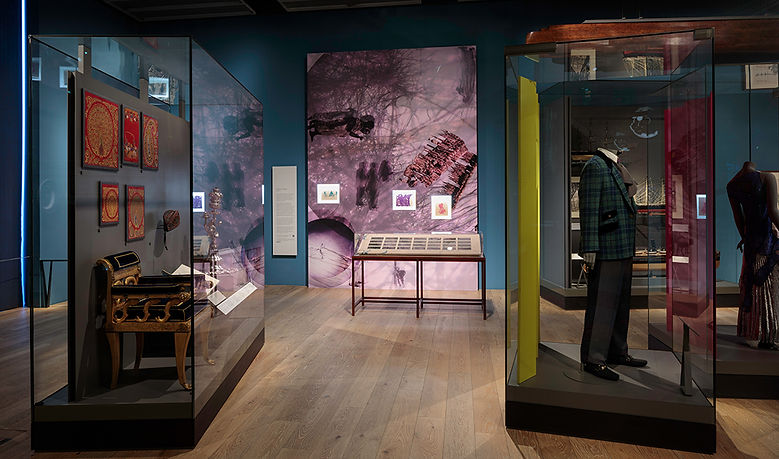
The Golden Fibre, 2021-2022
Digital collage with pencil, photolithographs on handmade jute paper from tree-wrapping material
Photo: Ruth Clark
V&A Dundee, Scotland
curated by Tiffany Boyle (Mother Tongue), and Meredith More


Tum Banglá mat bolo, ham kuchh nahin samajtha hai (You don't speak Bengali, I can't understand anything), 2021-2022
Sandblasted mirrors (3 x 7 in each), on handmade jute paper, with raw jute, and dyed pigment pulp.
Photo: Neil Hanna
In 2020, I was commissioned by V&A Dundee to create a new work for the Scottish Design Galleries which explores the colonial context of jute, a material woven into the stories of two cities: Dundee and Calcutta (now Kolkata, India). This commission builds on research from the Jute Mill archives at the University of Dundee and Verdant Works independently conducted in 2018, where I was working with photographs and documents that reveal fragments of the lives of jute industry workers in and around Calcutta, particularly women and children. A large-scale wall collage of images and drawings is punctured with three niches containing photolithographs on handmade jute paper. Ghostly images of unidentified figures from the archives and a still from 1951 film “The River” by Jean Renoir are layered together, in some cases distorted and pulled out of focus. Influenced by the academic work of Samita Sen, I focused on women in the industry whose experiences lie at an intersection of gender, caste, and class. In the mills, these women were often widows or had been sent away from their family homes to work. Many were not recorded as part of the workforce, especially those who worked in the fields to harvest the raw material. While Dipesh Chakrabarty writes about labour relations, workers’ rights, and protest through a Marxist lenses, Sen exposes how women were never represented by any labour laws and yet were integral to the industry, from the collection of the raw material in rural settings, to the finishing of jute products in what became urban centres.
The rise and fall of the jute industry is a well-known story in Dundee. Many of today’s residents are still personally connected to it through their parents and grandparents who worked in the factories and mills producing sacks, rope, sailcloth, and countless other utilitarian products. The commercial success of the Indian mills by around 1900 is often seen to have caused the decline of Dundee’s industry, leading to mass unemployment, but the Indian mills were in fact predominantly set up by Scots and run by Scottish supervisors for decades. The British colonial system, and many Scots, were still benefitting from the turn to Calcutta.
Underpinning my work is a fascination with the material properties of jute, and of the role of my hand (and the hands of many others before me) in making paper from it. This laborious process involves cutting jute cloth into small squares and soaking it in lye, before repeatedly beating it in water over a number of hours to make a pulp ready for shaping into sheets
and drying. At the pulping stage, the jute fibres unravel and bind together again on their
own in new configurations. I have incorporated microscopic images of the jute fibres (both raw and of the jute paper) blown up to a huge scale, and think of the organic behaviour of the fibres as a protest against order and structure. Like a drawing, the fibres make overlapping, intersecting lines, webbed into each other. I am interested in these images that make themselves.


Processed (scene from a mill in Dundee), 2019-2023
Photolithograph on handmade jute paper
Printed by Alastair Clark at Edinburgh Printmakers
I had made a series of drawings from the archives of the Jute Mills (University of Dundee) onto heavily gessoed and sanded wood board in 2018. Those drawings were scanned and then printed onto handmade jute paper at Edinburgh Printmakers by Alastair Clark, after I had selected the colour of ink. What I wanted was for the lines of the wood and sanding to appear in the drawing, as though the drawing itself was originally printed.

Selection of hand tools that I made from Verdant Works and Dundee Heritage Trust, also presnted in the Scottish Design Galleries.