

Translation, 2017
Water soluble graphite on handmade khadi paper, folded and crumpled repeatedly
Photograph by Paul Eekhoff/ROM
Collection of Royal Ontario Museum, Toronto
The work is titled “Translation” because materials have been translated into different surfaces for drawing. I started with the idea of the grid and have used geometric patterning found in Phulkaris (made by women in Punjab, a state that straddles both India and Pakistan), which forms its own grid. Traditional Phulkaris include an intentional mistake, or the nazar, which protects the wearer from the evil eye. Sometimes the nazar is seen as different coloured threads, sometimes it is a missing area. I am drawn to this because the nazar appears as an abberation, and breaks the perfect geometric patterning or the grid of patterning in tradtional Phulkaris. I am considering this form of embroidery as one that defies political borders. It has only ever been taught by the women of a household to one another and has never been commissioned by the royal courts and has therefore, always been a domestic art.
Once the handmade paper was taken out of the press and dryer, I repeatedly crumpled and ironed the paper before using it as drawing surface. I folded a grid into the paper before crumpling it; as paper maintains a memory of any action, the grid is an undercurrent that remains present. The paper behaves somewhere between cloth and paper in the Japanese technique of “momigami”, and includes a misaligned Phulkari motif. The “nazar” - as a superstition - is found in many cultures, and I am interested in how it is used as a form of protection.

Nazar, 2017
Water soluble graphite on handmade khadi paper
Photograph by Paul Eekhoff/ROM
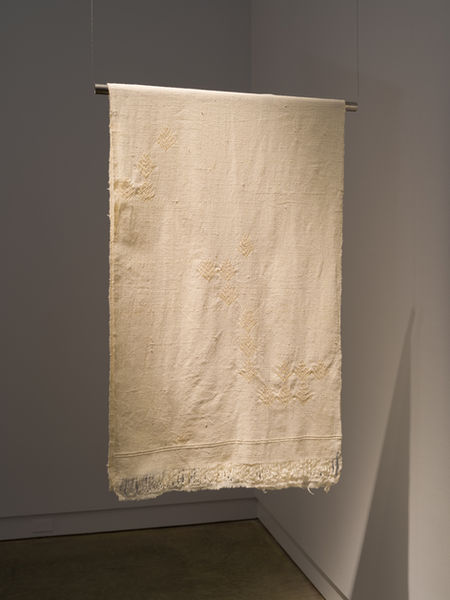
Translation, 2017
Cotton embroidery on undyed khaddar
Photograph by Dennis Ha
